
Medical Conditions That Qualify for Disability Tax Credit
In short
There is no list of medical conditions that qualify for the Disability Tax Credit. The Canada Revenue Agency does not ask what your child has. It asks what your child cannot do, and how often, and for how long. A diagnosis on its own qualifies nobody. A child with no diagnosis at all can still qualify.
There is no list. The Canada Revenue Agency does not publish a set of medical conditions that qualify for the Disability Tax Credit, because that is not how the credit is decided. The CRA asks what your child cannot do without help, how often, and for how long. Two children with the same diagnosis routinely get different answers, and that is the system working as designed rather than a mistake.
Most pages you will find today say otherwise. They show an alphabetical chart of eighty conditions and invite you to look yours up. I understand why they exist, and I will come back to who pays for them. But a parent whose child's condition is not on the chart walks away believing the door is closed, when it may not be.
This is about what actually decides the answer, and what to do when your child was diagnosed in another country. It is not tax advice, and it is not a promise that any particular child qualifies.
Steady Path Society provides peer navigation and information, not clinical care and not tax advice. Nothing here is nursing advice, a diagnosis, or a substitute for talking to your child's care team or a tax professional. I am a Registered Psychiatric Nurse; I do not practise nursing through Steady Path Society, and contacting us does not create a nurse-client relationship.
 A blank checklist on paper
There is no list of qualifying conditions
Autism does not qualify a child. Cerebral palsy does not qualify a child. Neither does epilepsy, Down syndrome, ADHD, or a hearing loss. What qualifies a child is the effect the condition has on ordinary daily life, certified by a medical practitioner who has examined them.
This cuts both ways, and the second way is the one worth knowing. A child with no formal diagnosis, still on a waiting list, can be found eligible if a practitioner can describe the restriction. Families give up at the diagnosis stage every year without knowing that.
 A child getting dressed in the morning
What the CRA actually measures
The assessment looks at whether a person is markedly restricted in at least one of these areas of everyday life:
- Speaking. Being understood by someone familiar with them, in a quiet setting
- Hearing. Understanding a familiar person, in a quiet setting
- Walking
- Elimination. Bowel or bladder functions
- Feeding
- Dressing
- The mental functions necessary for everyday life. Memory, attention, judgement, and adaptive functioning
Two further routes exist. One covers life-sustaining therapy needed to support a vital function. The other, added in 2005, covers the cumulative effect of significant restrictions in more than one area, for a child who is not markedly restricted in any single one but is meaningfully restricted across several.
The definitions are precise and the CRA changes them. Read the current criteria on the Canada Revenue Agency's eligibility page rather than trusting my summary or anyone else's, and if your child's difficulties are cognitive, the mental functions criteria are set out separately.
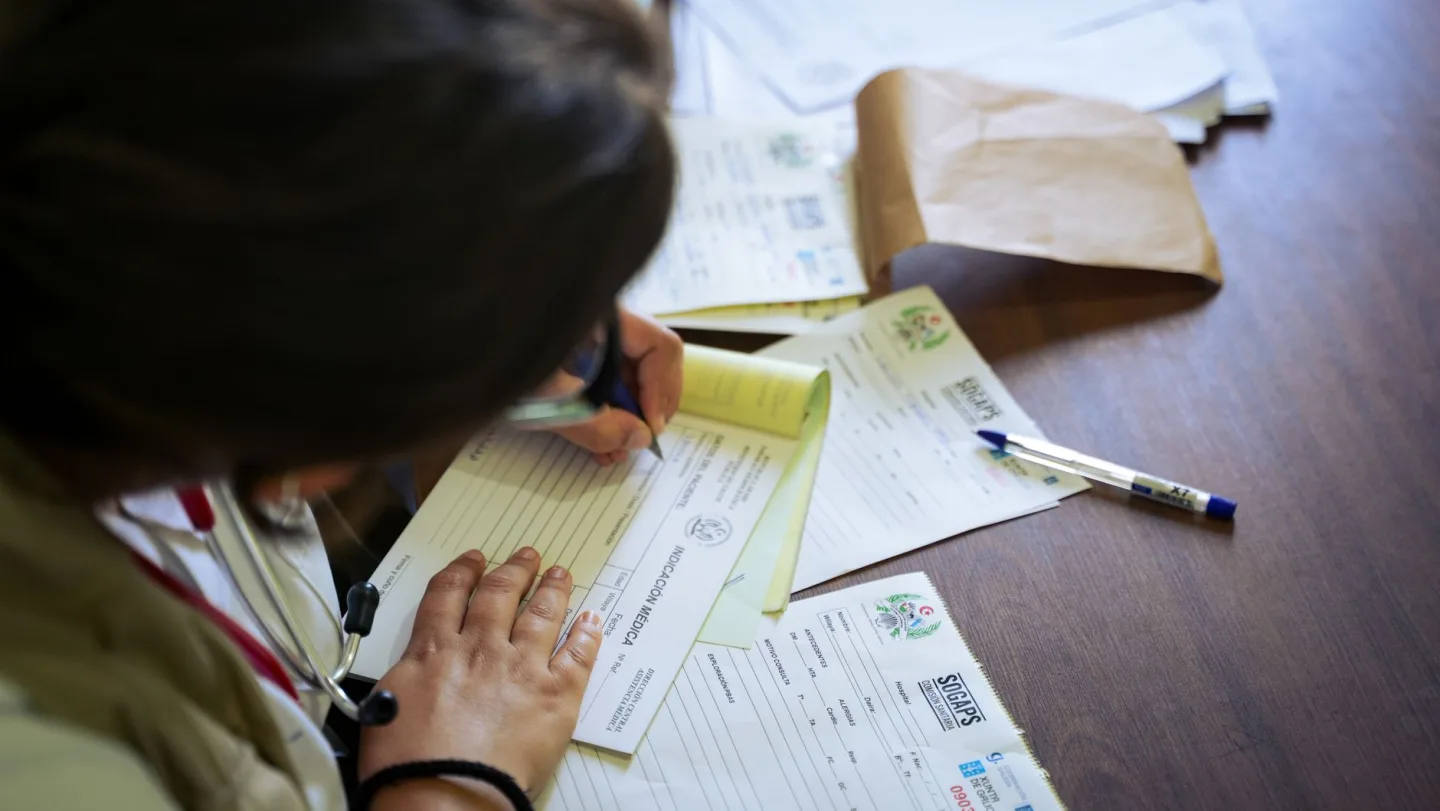 A clinician writing at a desk
The form has a half you cannot fill in yourself
The application is Form T2201. One part is yours. The other has to be completed by a medical practitioner, and it is the part that decides the outcome.
Who may certify depends on the restriction. A medical doctor or nurse practitioner can certify any of them. A psychologist can certify mental functions. An audiologist can certify hearing, an optometrist vision, a physiotherapist walking, an occupational therapist feeding, dressing and walking. If your child sees a specialist who knows them well, that specialist is often the better signature.
The practitioner is describing function, not writing a diagnosis letter. What helps them is specifics: how long dressing takes on an ordinary morning, how often you are woken at night, what happens on a walk to school. Write those down before the appointment. A practitioner with fifteen minutes and no notes will describe your child in general terms, and general terms are what get refused.
 A folder of documents spread on a table
If the diagnosis happened outside Canada
Nothing about the credit requires your child to have been assessed in Canada. But the form requires a practitioner licensed in Canada to certify the restriction, and that is a different thing from having a diagnosis.
So bring the records. Assessment reports, hospital letters, therapy notes, school reports from your home country. They do not need to be translated professionally for a first conversation, though a clear written summary helps. Their job is not to prove the diagnosis to the CRA. Their job is to let a Canadian practitioner see the history quickly, so the restriction they are certifying today has ten years behind it instead of one appointment.
I have watched families leave those documents in a suitcase for two years because nobody told them they mattered. They matter here, and they matter again at school.
 The reception desk of a walk-in clinic
If you do not have a family doctor yet
You do not need one to start, and you should not wait for one.
A walk-in clinic physician can complete the form. So can a nurse practitioner. If your child is already seeing a paediatrician, an audiologist, or an occupational therapist through the public system, any of them may be able to certify the part that matches their area. The practitioner does not need to have known your child for years, although one who has will write a stronger description.
What does help is going in once to establish the picture, then returning for the form. A practitioner who met your child ten minutes ago is being asked to certify how they manage an ordinary Tuesday. Give them something to work from. If you are still finding your way to a first appointment at all, I wrote a separate guide on raising a developmental concern with a doctor as a newcomer.
 A woman taking a phone call in her kitchen in the evening
The parent who could not do it alone
A friend of mine sent someone to me a few years ago. A parent in Prince George, nowhere near me, who needed to understand how to navigate the disability support system for their child and could not work it out alone.
They had read the pages. They had the diagnosis. They still could not see how the pieces connected, because the pages are written for people who already know what they are looking at.
We talked. No appointment, no fee, no form to fill in first. That was before Steady Path Society had a name, a registration number, or a website. It is the same conversation I have now, and the reason the organisation exists at all is that the conversation kept happening whether or not anyone was funding it.
 A calculator resting on household bills
You should not pay anyone a share of your refund
Several of the companies ranking above this page will file the form for you and keep a percentage of whatever the CRA pays out. That percentage is often between twenty and thirty per cent. On a retroactive claim going back several years, for a family that qualified for the credit precisely because raising a disabled child is expensive, it is a significant amount of money.
It is legal. Sometimes, for a complicated file, the help is real. But the ability to pay is not a measure of whether a family deserves help, and a family with limited income and a disabled child is exactly the family least able to give away a quarter of a refund. That is the whole reason Steady Path is a nonprofit rather than a practice. We have never charged a family, in twelve years of doing this, and we do not intend to start.
If you want help with the form, ask a community organisation, a settlement agency, or us, before you sign anything that takes a cut.
 A telephone handset resting on a table
When not to call me
Call the CRA, not me, if you need a decision on your own file, a status update, or an explanation of why a claim was refused. They hold the file and I do not.
Talk to an accountant or a tax professional, not me, if your question is about how the credit interacts with your return, a transfer to a supporting family member, or a retroactive adjustment. I am not qualified to answer that and I will tell you so on the phone.
Talk to your child's doctor or specialist about the medical content of the form. I cannot tell you whether your child is markedly restricted. Nobody outside a licensed practitioner can.
If your child is in immediate danger, call 911. For health advice tonight, call 8-1-1. Interpreters are available.
What I can do is sit with you and work out what the form is asking, what to write down before the appointment, and what to do next if the answer comes back no. That is what the navigation support is for, and it costs nothing.
 A woman writing a list by a window in the morning
Where to start this week
Book one appointment with whichever practitioner knows your child best. Before you go, write down what an ordinary day requires: how long each task takes, how often you help, what happens when you do not.
Find the records from your home country and put them in one folder.
Then read the current eligibility criteria yourself, once, slowly. If you want a wider view of what else your family may be entitled to, our guide to disability benefits for newcomer families in BC covers the ground around this one.
If the form comes back refused, that is not the end of it. Refusals are frequently about how the restriction was described rather than whether it exists.
 A parent pausing in thought at home
Frequently asked
Q.What conditions qualify you for the Disability Tax Credit?
None, on their own. The CRA does not assess the diagnosis. It assesses whether a person is markedly restricted in speaking, hearing, walking, elimination, feeding, dressing, or the mental functions of everyday life, or needs life-sustaining therapy. A diagnosis supports the application; it does not decide it.
Q.Can my child qualify without a diagnosis?
Yes. Eligibility rests on a medical practitioner certifying the restriction, not on a completed diagnosis. Children still waiting for an assessment are found eligible every year. If your child's daily functioning is markedly restricted now, the application does not have to wait for the assessment.
Q.What physical conditions qualify for disability?
The question is the effect, not the condition. A physical condition supports an application where it markedly restricts walking, feeding, dressing, or elimination, or where its effects across several areas are cumulatively significant. The same condition qualifies one child and not another.
Q.What conditions are not considered a disability?
The CRA does not maintain an excluded list either. Applications commonly fail where the restriction is intermittent, well managed with ordinary treatment, or described in general terms on the form. How the practitioner describes an ordinary day matters more than which condition is named.
Q.How hard is it to get approved for the Disability Tax Credit?
Harder than it should be, and the difficulty is usually in the paperwork rather than the child's situation. The most common avoidable problem is a form completed in a short appointment with no written detail from the parent. Bring specifics about an ordinary day.
Q.Does a diagnosis from another country count?
It counts as history and it is worth bringing. It cannot replace certification: a practitioner licensed in Canada must complete the medical part of the form. Records from your home country help that practitioner describe a long-standing restriction rather than a single appointment.
Q.How much back pay will I get for the Disability Tax Credit?
That depends on your income, the years claimed, and who claims it, so no honest answer exists without your file. Retroactive claims can cover several prior years. An accountant or the CRA can tell you what your situation produces; nobody else can.
Q.Does Steady Path Society charge for help with the form?
No. We have never charged a family and we take no share of any refund. We are a registered BC nonprofit, incorporation number S0085456. If you are being asked for a percentage of your refund, you can ask us first.
 A parent making a call from home
Still have questions?
Tell me where your family is with this: no diagnosis yet, a diagnosis from another country, a form half-filled, or a refusal you do not understand. We will work out the next step together.