
Developmental Concerns: Talking to a Doctor as a Newcomer
In short
Tell a doctor. If you do not have a family doctor yet, you do not have to wait for one. A walk-in clinic, a public health nurse, or 8-1-1 can all start the process. Bring written notes and any records from your home country. Ask for an interpreter; it is free. The immigration medical exam did not check your child's development.
Tell a doctor, and tell them in writing. If something about your child's development worries you, whether that is speech, walking, play, or how they respond to their name, the person who can start the process in British Columbia is a physician or a nurse practitioner. You do not need a diagnosis, a referral, or a Canadian medical history to raise it. You need one appointment and a piece of paper with your observations on it.
Most newcomer parents I meet have already waited months before they say anything. Not because they did not notice. Because they were told at home to wait and see, or because they were not sure it was allowed, or because there was no family doctor to tell. In the twelve years I have been doing this, that delay is the single most common thing I wish I could undo.
This is about the conversation with the doctor: who to tell, what to bring, and what happens if you have no doctor yet. It is not about diagnosis, and it is not about what the assessment finds.
Steady Path Society provides peer navigation and information, not clinical care. Nothing here is nursing advice, a diagnosis, or a substitute for talking to your child's doctor or care team. I am a Registered Psychiatric Nurse; I do not practise nursing through Steady Path Society, and contacting us does not create a nurse-client relationship.
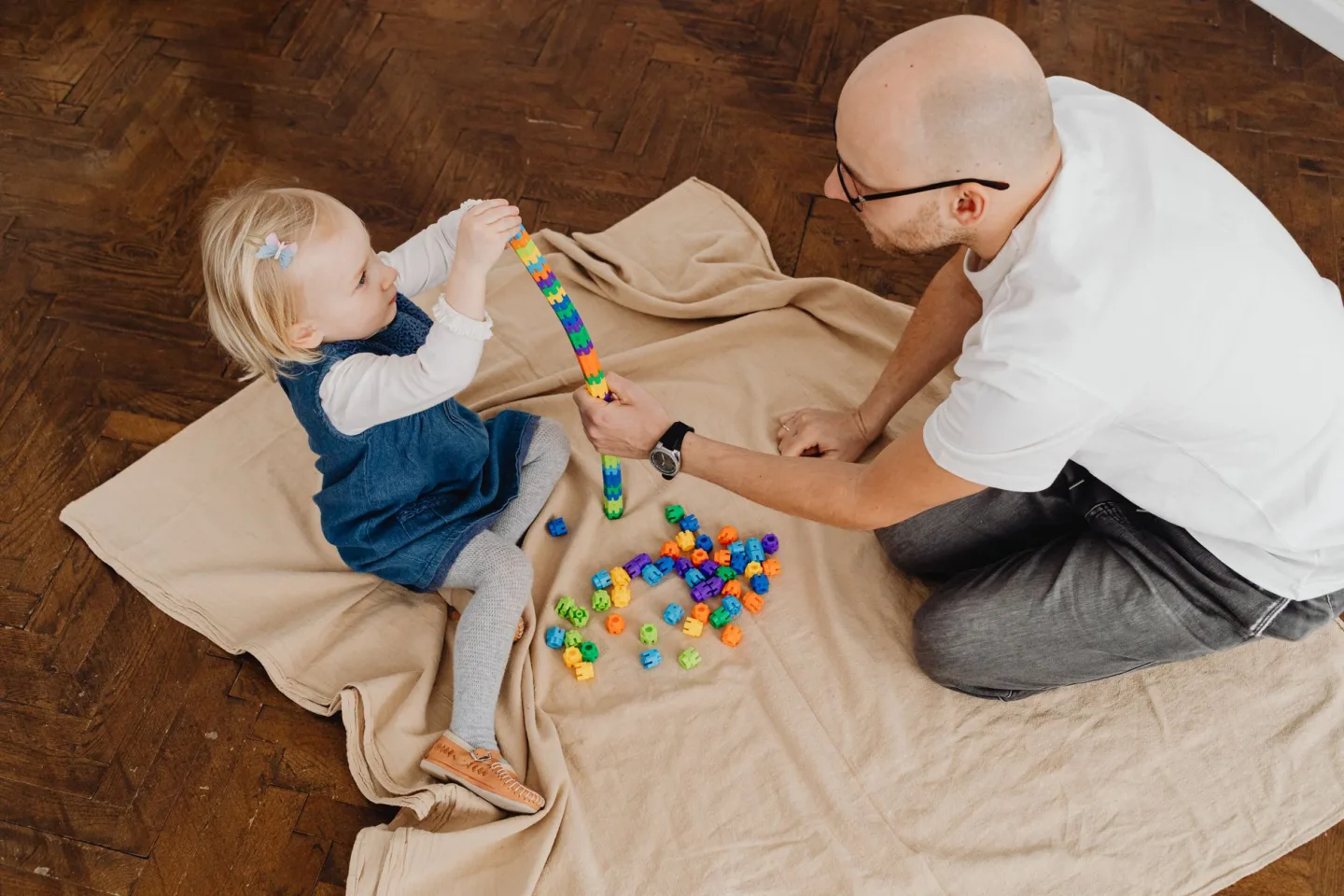 A toddler playing with wooden blocks on the floor
What a doctor means by "developmental concern"
It is a plain phrase that sounds clinical. It means: your child is not doing something most children do by roughly this age, or they did it and stopped.
That covers a wide range. Not babbling by twelve months. Not walking by eighteen. Very few words by two. Not responding to their name. Losing a skill they had. Difficulty with other children that does not settle. A child who was developing exactly as expected and then changed.
Two things worth knowing before you go in. A concern is not a diagnosis, and raising one does not commit you to anything. And you do not have to be right. The doctor's job is to work out whether there is something to look at. Yours is to say what you have seen.
Often it is not the parent who says it first
A mother I have known since university sent me her account last week. Her son is twenty-two now and on the autism spectrum. Her family moved from Nigeria to the United States when he was one.
My brother-in-law, a paediatrician, gently but firmly pointed out that my son's persistent babbling, in lieu of spoken words at his age, was unusual. He urged us to seek evaluation by a pediatric neurologist.
It was Thanksgiving. A family visit, not an appointment. Then the preschool called about torn-down classroom decorations and crying that would not stop. He was diagnosed at two.
I put that here because of the order it happened in. A relative noticed, then a school noticed, and the assessment came after both. If someone has said something to you about your child and it stung, that is worth writing down rather than arguing with. You can decide later whether they were right. The appointment is easier to get now than the year you spend deciding.
She is in Pennsylvania, not here, so none of the offices in this post were hers. What carries across is the part before any office: somebody said something, and it turned out to matter.
 Empty chairs in a clinic waiting room
You do not need a family doctor to start
Almost nothing written for newcomer families says this, which is why people wait.
A great many people in British Columbia do not have a family doctor, and if you landed this year you are almost certainly one of them. The waitlist is real. But the developmental pathway does not begin at a family doctor's office. It begins with any physician or nurse practitioner who will see your child.
Four doors, all of them open to you:
- A walk-in clinic. A walk-in physician can refer your child, so bring your notes and expect a short visit
- The Health Connect Registry. The provincial waitlist for a family doctor or nurse practitioner, worth joining now even though it will not help this month ( register through HealthLink BC)
- 8-1-1. Free, 24 hours, interpreters available, and the nurse who answers will tell you whether what you are describing needs an appointment and how soon
- A public health nurse. Through your local health unit, who sees children routinely and who in much of the province you can contact without a referral
If you have Medical Services Plan (MSP) coverage, all of these are covered. If your MSP is still in its waiting period, say so when you book rather than staying away. Clinics deal with this constantly, and your first weeks in BC covers how the coverage gap works.
I used to tell families to get on the family-doctor list first and raise the concern once they had one. I stopped. People were waiting a year to say a sentence that takes ninety seconds.
 Travel documents and a folder on a desk
The immigration medical exam did not check this
I hear this one often enough that it deserves its own section.
The immigration medical examination your family completed before arriving is a screening for a small set of public-health and admissibility conditions. It is not a developmental assessment. It does not test speech, motor skills, hearing in any detail, or social development.
A child can pass the IME completely and still have a developmental concern that needs looking at. Passing it tells you nothing either way, and a clean IME is not a reason to wait.
 Handwritten notes in an open notebook
What to bring, and what to write down
The appointment will be short. Ten minutes is common. What you bring decides how much of it is useful.
- Written observations. Dates, not adjectives. "In March he stopped saying the six words he had" is worth more than "his speech is behind." Two or three specific examples with rough dates.
- Your child's records from your home country. Immunisation records, growth charts, any assessment, any hospital note, even in another language, even handwritten. Bring the originals and a photo of them on your phone.
- What other people have said. If a preschool teacher, a relative, or a daycare worker has raised something, write down who said it and when. It is not gossip. It is a second observer.
- One sentence you have decided in advance. Say it in the first minute, before anything else. "I am worried about my child's development and I would like to know if he should be assessed." Write it down and read it if you need to.
- Your questions, on paper. You will forget them. Everyone does.
That fourth one matters more than it looks. A short appointment fills up with the reason you booked it. If you booked for a cough and raise development at minute nine, you will be asked to book again.
 A clinician talking with a patient in a consultation room
Ask for an interpreter, and ask before the day
You are entitled to an interpreter in a BC health appointment, and it does not cost you anything. Ask when you book, not when you arrive. A phone or video interpreter usually has to be arranged in advance.
Please do not bring your child to interpret for you. I know why families do it. It is quicker, it is free, and your daughter's English is better than yours. But she is the subject of the conversation, and she should not have to translate a sentence about her own development, or a sentence you are trying to protect her from.
An adult relative is better than a child, and a professional interpreter is better than a relative. A professional will translate what the doctor actually said, including the part nobody in the room wants to hear.
 A wall calendar marked with dates
How long this takes, honestly
Getting seen is fast. Being assessed is not.
Raising the concern takes one appointment. A referral goes out within days or weeks. Then the wait begins, and in British Columbia it is long. For a developmental or autism assessment through the public system, many families wait many months, and often more than a year. I have written separately about how to get a free autism assessment in BC, because the waiting is where families lose momentum.
The referral date is what matters, and it is set the day you raise it. Every month you delay is a month added to the end, not the beginning. Meanwhile, school and therapy supports do not require a completed assessment. School and IEP support in BC starts from need, not from a diagnosis.
The wait does not get better. I have been saying it is too long since 2014 and it is still too long. Plan around it rather than waiting on it.
 Young children playing together in a preschool classroom
Ten years ago, at a kindergarten gradual entry
I met Veronica at Moody Elementary in Port Moody, at the gradual entry days when our children were starting kindergarten. She had arrived in Canada not long before, with three young children, on her own. I showed her where the grocery stores were and what to buy. Most mornings I asked whether she had eaten breakfast, and when the answer was no I took her home and fed her.
In 2019 her daughter was diagnosed with a form of childhood epilepsy. Nothing about the years before had prepared her for it. She needed someone who had already sat in those rooms.
She wrote this herself, and asked me to put it here:
Fast forward to 2019, when my daughter was diagnosed with juvenile absence epilepsy. I was confused and heartbroken, and I often found myself crying. Once again, Cordelia was there. She encouraged me, comforted me, and shared her own experiences of raising a child with special needs. Her wisdom guided me through some of my darkest moments and helped me learn how to advocate for my daughter's wellbeing with confidence and clarity.
Veronica went back to school after that. She finished a diploma in Social Services and is now completing a Bachelor of Social Work.
None of that was a program. There was no organisation, no intake form, no funding. Steady Path Society was registered in 2026, and it has been real since 2014. The paperwork caught up to the work. If you are reading this without anyone in the country who has done it before, that is the gap this exists to fill, and it is a real one.
 A telephone handset resting on a table
When not to call me
I am not the first call for everything, and pretending otherwise would waste time you do not have.
If your child is in immediate danger, or is hurt, call 911. If you need health advice tonight, call 8-1-1 and speak to a nurse. Interpreters are available.
If you want your child assessed or diagnosed, that is the paediatrician and the assessment team. I cannot do it, and I would not want a family relying on me for it. If you need therapy, for your child or for yourself, you need a registered clinical counsellor or a psychologist, and I can help you find one, but I am not one.
What I can do is the part in between: what to say at the appointment, what the letter means, who to call next, and what nobody told you was available.
 A woman writing a list by a window in the morning
Where to start this week
Write down three things you have noticed, with rough dates. Book one appointment. Walk-in is fine. Ask for an interpreter when you book. Say your sentence in the first minute.
If any of that feels like more than you can face this week, that is normal, and it is the reason we walk families through the health and school systems step by step. It costs nothing.
Whatever you decide about the rest of it, book the appointment before you finish this week.
 A parent pausing in thought at home
Frequently asked
Q.Who do I talk to first if I'm worried about my child's development in BC?
A physician or nurse practitioner. That can be a family doctor, a walk-in clinic doctor, or a public health nurse. You do not need an existing relationship with one. They are the people who can make the referral for a developmental assessment.
Q.Can I start without a family doctor?
Yes. A walk-in clinic physician can refer your child, and a public health nurse can see them in most of BC without a referral. Join the Health Connect Registry for a permanent doctor, but do not wait for it before raising the concern.
Q.Did the immigration medical exam already check my child's development?
No. The immigration medical examination screens for a specific set of public-health and admissibility conditions. It does not assess speech, motor skills, or social development. A child can pass it and still need a developmental assessment.
Q.Can I get an interpreter at a doctor's appointment, and does it cost anything?
Yes, and it is free. Interpretation in a BC health appointment is provided at no cost to you. Ask when you book rather than on the day, because a phone or video interpreter usually needs to be arranged in advance.
Q.How long is the wait for a developmental assessment in BC?
Long. Through the public system families often wait many months, and frequently more than a year, from referral to assessment. The referral date is set the day you raise the concern, which is why raising it early matters even though the wait does not change.
Q.Do I need a diagnosis before my child's school will help?
No. BC schools put supports in place based on a child's needs, not on a completed diagnosis. Ask the school's learning-support team for a meeting as soon as you have raised the concern with a doctor.
Q.Will raising a concern affect our immigration status?
Raising a developmental concern with a doctor is health care, not an immigration process. If you have a specific worry about medical inadmissibility or a permanent-residence application in progress, speak to an immigration lawyer or a settlement agency. That is a legal question, not a medical one.
Q.Can Steady Path Society diagnose or treat my child?
No. Diagnosis and treatment belong to your child's doctor and the assessment team. Steady Path helps with the navigation around them: preparing for appointments, understanding what you are told, and finding what is available. It is free.
 A parent making a call from home
Still have questions?
Tell me what you have noticed and where your family is in the process. We will work out who to call first and what to say when they answer.